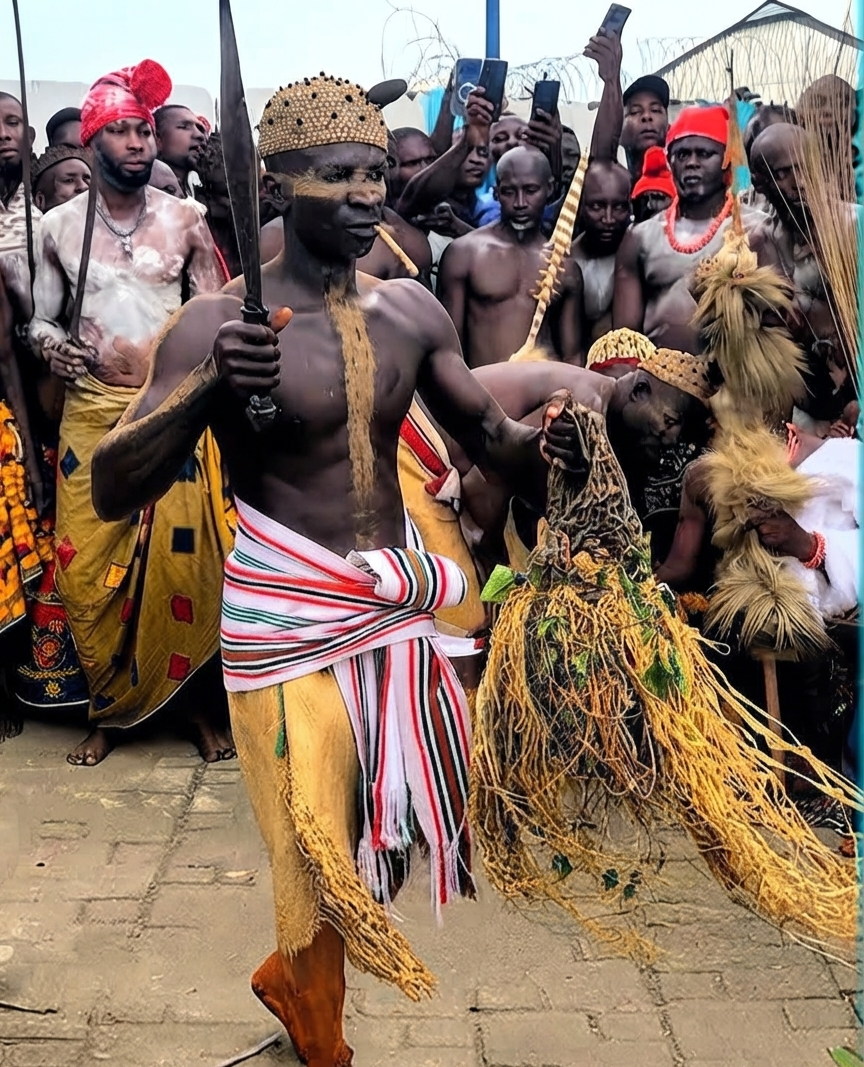
The Ebinyang, also known as Opalapala, is the Chief Priest and spiritual head of Ugep. He occupies one of the most sacred traditional positions in Ugep society and is regarded as “the eye of the gods”—a custodian believed to stand between the people, their traditional institutions and the spiritual world.
The office of the Ebinyang is much more than a traditional title. It is a sacred institution connected to some of Ugep's oldest spiritual and cultural practices, including Kota, Ekoi and traditional cleansing rites.
Unlike ordinary chieftaincy positions, the Ebinyang stool follows a traditional system of succession and rotates among three royal patriclans of Ugep.
THE THREE CLANS OF THE EBINYANG STOOL
Traditionally, the Ebinyang stool rotates among three royal patriclans:
1. Ugom — Ijiman
2. Kekomkolo — Ijom
3. Egbizum — Ikpakapit
The rotational system ensures that the sacred office is not permanently held by one clan.
When an Ebinyang dies, the succession process moves to the clan whose turn it is to provide the next holder of the stool.
This rotational arrangement is an important part of the traditional organisation surrounding the office.
HOW IS AN EBINYANG SELECTED?
The selection of an Ebinyang is not treated as an ordinary appointment. It is a traditional process involving the custodians and representatives of Ugep's traditional institutions.
When the person identified for the office is presented, the chiefs throw a traditional white towel towards him.
His response is significant.
When he picks up the towel, it signifies his acceptance of the call.
From that moment, the man's life begins to change. He has accepted a sacred responsibility connected to the spiritual and traditional wellbeing of Ugep.
KUPKOL: THE SIX-MONTH CONFINEMENT
Following his selection, the new Ebinyang enters a traditional period of confinement known as Kupkol.
Kupkol lasts for six months, during which the new Ebinyang stays in the house of his predecessor.
This period is regarded as an important stage of spiritual preparation. According to traditional accounts, the gods of vengeance guide and prepare him during this period for the spiritual responsibilities attached to the office.
Kupkol separates him from his former ordinary life and prepares him for the identity and responsibilities that come with becoming Ebinyang.
It is, in many ways, a transition from one life into another.
The significance of Kupkol also explains why the selection of an Ebinyang is not simply the appointment of another traditional chief. The man is expected to undergo a period of transformation before fully assuming the responsibilities of the sacred office.
THE RITES OF PASSAGE
The installation of the Ebinyang involves several traditional rites.
One of the notable rites is the traditional ceremony in which his teeth are “broken.”
The ceremony takes place at the palace of the Obol Lopon of Ugep, the paramount traditional ruler of Ugep.
Representatives of the three royal clans, chiefs, youths, members of the Kepon, and the wife of the Ebinyang are traditionally involved in the ceremony.
The rite marks an important stage in his transformation and acceptance into the sacred office.
OPALAPALA: A LIFE SET APART
The name Opalapala is closely associated with one of the most distinctive traditions surrounding the Ebinyang.
An Opalapala is traditionally a person who does not wear a shirt.
For the Ebinyang, this restriction begins with his installation and continues for the rest of his life.
After completing Kupkol and undergoing the required rites, he traditionally emerges wearing a raffia skirt and using ejono as body cosmetic.
From that point forward, he does not wear a shirt.
This is not understood simply as a matter of clothing. It is a visible sign that the Ebinyang has been set apart from ordinary life for a sacred purpose.
THE RULE EXTENDS TO HIS HOUSEHOLD
The traditional restrictions associated with Opalapala extend beyond the Ebinyang himself.
Members of his household traditionally do not wear shirts within the place where he lives.
The residence of the Ebinyang is therefore treated differently from an ordinary home, with its own traditional restrictions.
Likewise, a person approaching the Ebinyang is traditionally expected not to come before him wearing a shirt.
These rules reinforce the distinctive status of the office and serve as visible reminders of the sacred obligations attached to it.
CONTACT WITH THE EBINYANG AND CLEANSING
Traditional accounts also place particular importance on physical contact with the Ebinyang.
Anyone who touches the Ebinyang is traditionally required to undergo cleansing.
This practice reflects the belief that contact with the Ebinyang carries spiritual significance and cannot simply be treated as ordinary physical interaction.
The requirement for cleansing is therefore part of the wider system of ritual purity surrounding the office.
It also demonstrates why the Ebinyang is approached differently from other traditional leaders.
PAYING HOMAGE TO THE TEN MATRILINEAL CLANS
Following his emergence from Kupkol and the completion of the necessary rites, the new Ebinyang pays homage to the ten matrilineal clans of Ugep.
This forms part of his wider acceptance and installation and symbolically connects the newly installed Ebinyang to the entire Ugep community.
Although the stool rotates among three royal patriclans, the office itself serves the whole of Ugep.
DUTIES AND RESPONSIBILITIES OF THE EBINYANG
The authority of the Ebinyang extends into some of the most sacred areas of Ugep traditional life.
1. CUSTODIAN OF KOTA
The Ebinyang is the head and custodian of the Kota male initiation cult.
Kota belongs to the three royal clans and is traditionally held every six years, as well as on occasions associated with the death of an Ebinyang.
Kota is a sacred institution governed by traditional rules concerning participation and observation.
Among these rules is the restriction that women do not watch the Kota procession or activities.
The Ebinyang therefore plays a central role in maintaining the traditions, sacred objects and rituals associated with Kota.
2. CHIEF PRIEST FOR CLEANSING
The Ebinyang performs traditional cleansing rites following certain events regarded as spiritually significant.
These include circumstances involving:
- suicide;
- murder;
- accidents; and
- other situations requiring traditional purification.
Through these rites, the Ebinyang is traditionally believed to restore spiritual balance and protect the community from possible spiritual consequences associated with such events.
The cleansing required following physical contact with the Ebinyang is also part of this broader traditional understanding of ritual purity.
3. CUSTODIAN OF EKOI
The Ebinyang is traditionally regarded as a principal custodian of Ekoi and its associated traditions.
Ekoi is deeply connected to Ugep's cultural and spiritual identity and forms an important part of the Leboku/Ekoi Festival.
The Ebinyang therefore has an important responsibility in ensuring that the spiritual and traditional requirements connected with the celebration are observed.
4. GUARDIAN OF THE KOTA EMBLEM
The Ebinyang safeguards the sacred emblem associated with Kota and performs the traditional rituals connected to it.
This places him at the centre of one of Ugep's most important traditional institutions.
Through these responsibilities, the Ebinyang serves as a bridge between Ugep's traditional institutions and the spiritual order with which they are associated.
THE EBINYANG AND THE SPIRITUAL LIFE OF UGEP
The Ebinyang occupies a position unlike that of an ordinary chief.
While other traditional institutions may focus on community administration, representation, social organisation, land or other areas of communal life, the authority of the Ebinyang is fundamentally spiritual and ritual.
He is traditionally called upon when cleansing is required, when sacred rites must be performed and when institutions such as Kota and Ekoi require spiritual oversight.
This is why the Ebinyang is often described as the spiritual father of Ugep.
His responsibility does not end with the clan from which he emerged. Once installed, his traditional role is connected to the wider community.
A UNIQUE TRADITION
Among Ugep's traditional offices, the Ebinyang is particularly distinguished by his clothing restriction.
From the day of his installation until his death, he traditionally does not wear a shirt.
This is one of the clearest outward signs of his office and is closely connected to the name Opalapala.
The rule also extends into his household, where shirts are traditionally not worn within his residence. Visitors approaching him are likewise expected to observe the traditional restriction.
Together with the requirement for cleansing after physical contact, these practices create a distinct set of rules surrounding the Ebinyang and his residence.
They are not merely customs of appearance. They are expressions of the sacred status attached to the office.
LONGEST-SERVING EBINYANG
According to the historical accounts currently available to Discover Ugep, Obol Usang Ikpi is recorded as the longest-serving Ebinyang in Ugep history.
His tenure forms part of the historical record of the institution and provides an important reference in understanding the succession and development of the Ebinyang stool.
WHY THE EBINYANG MATTERS
The Ebinyang is more than a title.
He represents an important link between Ugep's traditional institutions, spiritual beliefs and cultural practices.
Through the office, sacred rites are preserved, traditional institutions are given spiritual oversight, and practices associated with Kota, Ekoi and traditional cleansing continue to have a recognised custodian.
The rotation of the stool among Ugom, Kekomkolo and Egbizum also demonstrates that the institution is not the permanent possession of one clan.
The stool belongs to the tradition and serves the wider Ugep community.
In simple terms, the Ebinyang is Ugep's spiritual father—the custodian of sacred traditions and the traditional priest responsible for maintaining the spiritual relationship between the community and its ancestral order.
He is feared because of the spiritual authority associated with his office, respected because of the responsibility he carries, and regarded as essential to the continuation of certain sacred institutions of Ugep.
The Ebinyang is therefore not merely a chief. He is an institution.
---
RESEARCH & SOURCES NOTE
This entry was prepared for the Discover Ugep Digital Archive as part of its ongoing effort to document, preserve and make accessible the history, culture, traditional institutions and heritage of Ugep.
The information presented here was independently reviewed, researched and cross-checked using available historical accounts and traditional information. A Facebook publication by Ojeka Odey Mathias (Sagacious), titled “Things to Know About the Selection and Duties of the Ugep Ebinyang,” was consulted as one of the preliminary sources for this entry.
Discover Ugep subsequently reviewed the information, verified key details where possible, incorporated additional traditional information, and reorganised the material into an encyclopedic archival format.
Source attribution: Ojeka Odey Mathias (Sagacious)
Editorial research & archival documentation: Discover Ugep Digital Archive
Where aspects of Ugep traditional history are based on oral tradition or community accounts, they are presented as such and may be subject to further documentation and scholarly verification.