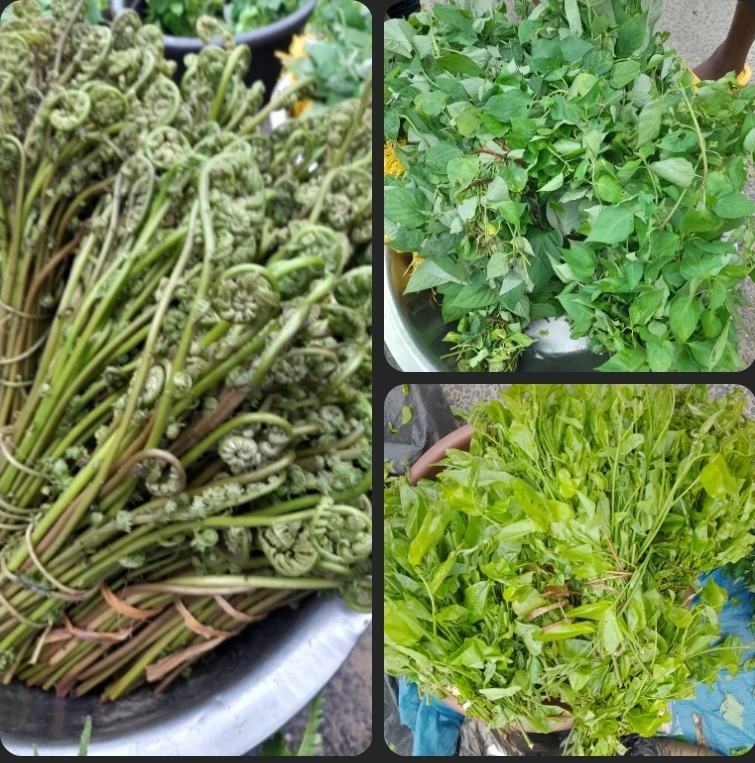
A culinary record of indigenous vegetables, preparation methods and food knowledge in Ugep
Food is more than nourishment. In many traditional societies, it is also a repository of memory, language, identity and knowledge. The ingredients used, the names given to them, the way they are harvested, prepared and cooked, and even the rules surrounding their preparation can tell stories about a people and their relationship with their environment.
In Ugep, vegetables occupy an important place within this food tradition. They are not simply ingredients added to a pot of soup; different vegetables can influence the taste, texture, appearance, preparation method and character of a meal.
Some are gathered from the farm, some are prepared differently because of their texture or taste, and some have particular handling practices that have been passed down through generations.
One interesting feature of Ugep vegetable cooking is that different vegetables can be prepared using a broadly similar soup base while producing distinctly different meals.
This is the idea behind One Soup, Many Flavours.
This entry documents some of the indigenous vegetables used in Ugep cooking, their Ugep names, distinguishing characteristics and traditional preparation practices as currently documented.
Documentation note: The English/common names and botanical identities of some of the vegetables documented here are still being established. Discover Ugep will continue working with knowledgeable elders, farmers, cooks, researchers and relevant specialists to verify and document these identities.
THE COMMON BASE
Although individual households may have their own recipes and preferences, a common approach to preparing these vegetable soups begins with a well-prepared stock.
The stock may be made from meat, fresh fish, smoked fish, or a combination of these, depending on the household, availability of ingredients and the type of meal being prepared.
Palm oil, pepper, onion and crayfish may then be incorporated to develop the flavour of the soup.
The vegetable itself is generally prepared separately according to its characteristics. Once the soup base has cooked sufficiently and the meat or fish has been incorporated, the selected vegetable is introduced.
This stage is important because the vegetables do not all behave in the same way.
Some have broad leaves. Others have small leaves. Some are smooth and soft, while others have a slightly chewy texture. Some require particular care when washing or cutting, while others can simply be shredded and added to the pot.
Consequently, the vegetable becomes the defining character of the soup.
The stock may remain similar, but the final meal can be noticeably different.
THE VEGETABLES
1. OBUDEMO
Ugep Name: Obudèmo
Common/English Name: To be confirmed
Botanical Identification: To be confirmed
Obudèmo is a leafy vegetable traditionally used in Ugep cooking. One of its distinguishing characteristics is its bitter taste, although the intensity of the bitterness may vary, and not everyone experiences it in exactly the same way.
The leaf is narrower than the broader leaves known as libagha, a distinction that is becoming increasingly important to document because the two are sometimes confused, particularly among younger generations.
TRADITIONAL PREPARATION
Obudèmo is handled differently from some other Ugep vegetables.
According to the documented preparation practice, the leaf is not squeezed while being washed. It is also not immediately stirred vigorously into the soup after being added.
The leaf is traditionally torn by hand rather than cut with a knife, although it may also be cooked without being cut.
These practices are not merely matters of convenience. They form part of the traditional knowledge associated with the vegetable and demonstrate how preparation techniques can differ from one indigenous food plant to another.
2. LIBAGHA
Ugep Name: Libagha
Common/English Name: To be confirmed
Botanical Identification: To be confirmed
Libagha is distinguished by its broader leaves, making it visually different from Obudèmo despite the fact that the two are sometimes confused.
TRADITIONAL PREPARATION.
Unlike Obudèmo, Libagha can be safely squeezed while being washed.
The leaves are shredded before being introduced into the soup. It can also be stirred into the soup immediately before serving.
Its preparation illustrates an important principle in traditional food knowledge: similar-looking vegetables may require different handling methods.
3. O'KO
Ugep Name: Oko
Common/English Name: To be confirmed
Botanical Identification: To be confirmed
Oko is described as having a very smooth texture, with a preference for leaves that are soft and tender.
Its preparation is comparatively straightforward.
TRADITIONAL PREPARATION
The leaves are simply shredded and washed before being introduced into the soup.
No special precaution regarding cutting, squeezing or delayed stirring has been documented for Oko in this collection.
4. LOKUKUNTI
Ugep Name: Lokukunti
Common/English Name: To be confirmed
Botanical Identification: To be confirmed
Lokukunti is a vegetable obtained from the farm and is characterized by a smooth texture similar to Oko.
Its inclusion in this collection also highlights the relationship between Ugep cuisine and agricultural knowledge. Understanding traditional food is not limited to knowing what happens in the kitchen; it also involves understanding where food comes from and how it is obtained.
TRADITIONAL PREPARATION
Lokukunti is used fresh, with light processing before it is shredded for cooking.
Its preparation is relatively simple, reflecting its soft and smooth nature.
5. UTENTEN
Ugep Name: Utenten
Common/English Name: To be confirmed
Botanical Identification: To be confirmed
Utenten is another farm-gained vegetable documented in this collection.
Its texture is described as being similar to Lokukunti, giving it a smooth character.
TRADITIONAL PREPARATION.
Utenten can be shredded before cooking or cooked whole.
Its small leaves make whole-leaf cooking possible, demonstrating again how the physical characteristics of an indigenous plant can influence the way it is prepared.
6. KUKPANNA
Ugep Name: Kukpanna
Common/English Name: To be confirmed
Botanical Identification: To be confirmed
Kukpanna differs from some of the smoother vegetables in this collection.
The leaf has a relatively straight shape and is not as smooth in texture as Oko, Lokukunti or Utenten.
TRADITIONAL PREPARATION
Kukpanna is traditionally shredded before being added to the soup.
The cooked vegetable has a slightly chewy texture, giving the finished soup a character distinct from vegetables with softer or smoother leaves.
THE FINAL TOUCH.
Regardless of the vegetable being prepared, the point at which it is introduced into the soup can influence the final result.
The vegetable is generally added towards the latter part of cooking, allowing it to retain more of its natural character rather than being subjected to prolonged cooking.
Once introduced, the soup is stirred gently and allowed to remain on the heat long enough for the vegetable to blend with the soup base.
And then, it is ready.
But the simplicity of this final stage should not obscure the knowledge behind it.
Knowing when to add a vegetable, how to wash it, whether to squeeze it, whether to tear or cut it, and how long to cook it is part of the culinary knowledge transmitted within households and communities.
MORE THAN A RECIPE.
There is rarely one single way to prepare traditional food.
Different Ugep households may prepare the same vegetable differently. One family may prefer a particular method of cutting; another may use a different combination of ingredients. Some households may prefer a particular vegetable with meat, while others may traditionally prepare it with fish or smoked fish.
These differences should not necessarily be viewed as contradictions.
They are part of the richness of indigenous food culture.
Traditional cuisine is often living knowledge. It changes gradually as people move, marry, travel, farm, trade and encounter new ingredients, while certain core practices continue to survive within families and communities.
The kitchen therefore becomes more than a place where food is prepared.
It becomes a place where language, memory, agricultural knowledge, family traditions and cultural identity are transmitted.
A child who learns the name of a vegetable in Lokaa is learning more than the name of a plant.
A young person who learns how an elder washes, cuts or cooks that vegetable is receiving knowledge that may have been passed through several generations.
And a farmer who knows where that vegetable grows is preserving another part of the same knowledge system.
FOOD, LANGUAGE AND CULTURAL MEMORY.
The documentation of indigenous vegetables is particularly important at a time when younger generations may increasingly encounter traditional foods without knowing their original names or preparation methods.
When a vegetable is known only by an English or commercial name, part of its local identity can gradually disappear.
Recording the Ugep name alongside its English or botanical identification provides an opportunity to preserve both the food and the language associated with it.
This is especially significant for Ugep people living outside their homeland.
For someone living in another Nigerian city or abroad, learning the name of a traditional vegetable, remembering the way it was prepared at home, or teaching a child how a particular soup was made can become a small but meaningful connection to Ugep.
The preservation of food culture is therefore also a form of preserving belonging.
ONE SOUP, MANY FLAVOURS.
The vegetables documented here may share a similar soup base, but each brings something different to the pot.
One may introduce bitterness.
Another may contribute a soft, smooth texture.
Another may have broader leaves.
Another may be slightly chewy.
Another may require special handling before cooking.
These differences are what make the collection valuable.
They remind us that indigenous cuisine is not simply a list of ingredients. It is a system of knowledge—knowledge of plants, farms, seasons, preparation, language, taste and family tradition.
The names may differ.
The cuts may vary.
The combinations may change.
But each vegetable carries a piece of Ugep with it.
And when that knowledge is documented, taught and passed on, the food does more than feed the body.
It helps preserve a people.
DOCUMENTATION AND ATTRIBUTION.
Original documentation and compilation of Ugep native vegetables by Wokeyim Okoi. Discover Ugep has expanded, organized and editorially developed the material for the purpose of cultural documentation, education and preservation.
Discover Ugep
Preserving the past. Inspiring the future.