From an Early Tradition to a Modern Cultural Spectacle
Original contributor: Sam Eno, PhD
Executive Director, The African Research and Development House
Edited and adapted for the Discover Ugep Digital Museum by Discover Ugep
---
Introduction
The history of Etangala in Ugep is a story of cultural memory, interruption, exchange and revival.
For many years, the commonly circulated account has been that Etangala was introduced to Ugep from the neighbouring community of Nko in 1986. While 1986 represents an important turning point in the modern history of Etangala in Ugep, oral testimony suggests that the masquerade had a presence in Ugep several decades earlier.
This account, contributed by Sam Eno, PhD, draws particularly from personal childhood memories and recollections associated with Usaja and Egbizum. It also describes the circumstances surrounding the revival of Etangala in Ugep in 1986 and its subsequent development into a major attraction of the Ugep New Yam Festival.
Because portions of this history are based on oral tradition and personal recollection, they should be understood as part of Ugep's growing body of oral historical records and should be further examined alongside testimonies from elders, community custodians and other historical sources.
Etangala in Ugep Before 1986
According to the contributor's childhood recollection, Etangala was already known and performed in parts of Ugep in the 1960s.
Dr. Sam Eno recalls witnessing Etangala in Ugep in 1967, when he was approximately seven years old. He particularly associates the early performances with Usaja and Egbizum.
Among the performers he remembers were Eno Njong, described as a tall and striking figure from Usaja, and Bassey Ferdinand, another imposing performer associated with the tradition at the time.
For a young observer, the masquerade was a memorable spectacle. Yet beyond the childhood fascination was a cultural tradition whose existence, according to this testimony, predates the better-known 1986 revival.
The contributor suggests that this aspect of Etangala's history may still be recalled by older residents of Usaja, Egbizum and Lekpankom, particularly those who were old enough to have witnessed the tradition before the Nigerian Civil War.
The Civil War and the Disappearance of the Early Tradition
The outbreak of the Nigerian Civil War in 1967 disrupted many aspects of social and cultural life across the region.
According to the account, Bassey Ferdinand, one of the individuals associated with the Etangala performances at the time, subsequently joined the army. With his departure and the wider disruption caused by the war, the form of Etangala known in these parts of Ugep reportedly ceased to continue.
The tradition therefore entered a period of inactivity.
In the years that followed, Etangala became increasingly prominent in Nko, where the masquerade developed into a significant cultural performance.
Ugep youths travelled to Nko to witness the spectacle, creating a renewed familiarity with Etangala among a younger generation of Ugep people.
1986: The Revival of Etangala in Ugep
A significant turning point came in 1986.
According to the account, an accident involving some Ugep youths returning from an Etangala performance in Nko, around the Convention School area, generated renewed community interest in bringing the masquerade back to Ugep.
The people of Emenko in Bikobiko subsequently approached the late Obol Ubi Ujong, then Obol Lopon of Ugep and Paramount Ruler of Yakurr, seeking permission to travel to Nko, study the organisation and performance of its Etangala, and return with the knowledge necessary to establish the tradition in Ugep.
Permission was reportedly granted.
Members of the community travelled to Nko, observed and learned the performance, and subsequently returned to Ugep.
This episode is important because it helps explain the distinction between the earlier Etangala tradition remembered in Ugep and the modern form of Etangala that emerged in Ugep from 1986 onward.
Thus, 1986 may be understood as a major revival and transformation point, rather than necessarily the first appearance of Etangala in Ugep.
From Revival to Cultural Institution
Following its return, Etangala evolved considerably.
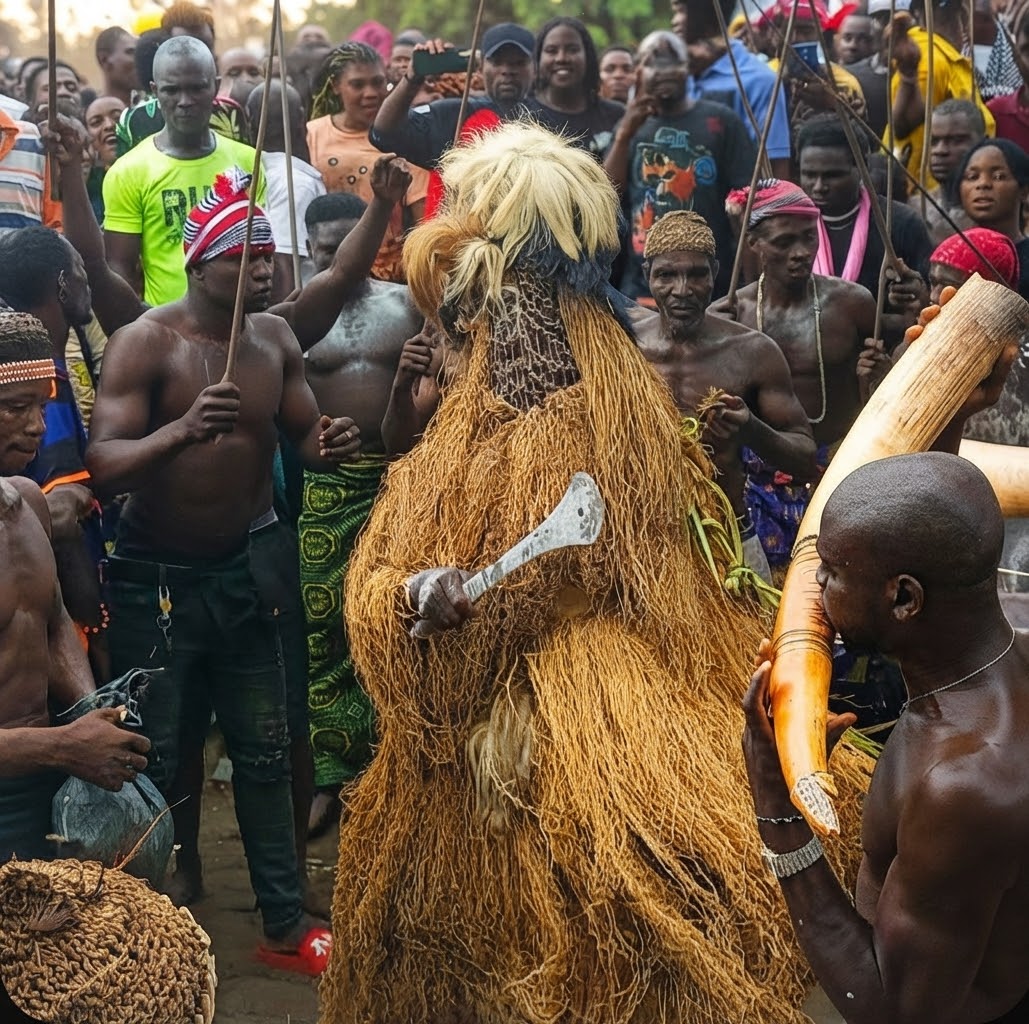
The performance became increasingly organised and visually elaborate, incorporating distinctive costumes, music, movement and presentation. Over time, it became closely associated with the cultural celebrations surrounding the Ugep New Yam Festival.
The development demonstrates how cultural traditions can change when they are reintroduced into a different social environment.
While the modern Ugep form was significantly influenced by the Etangala observed in Nko, the tradition was subsequently embraced, organised and developed within Ugep.
It became part of the community's own cultural expression.
Etangala and the Ugep New Yam Festival
Today, Etangala is among the prominent cultural attractions associated with the Ugep New Yam Festival.
Its performances bring together residents, visitors, cultural enthusiasts and spectators from different parts of Yakurr and beyond. The streets become spaces for cultural display, with elaborate costumes, music, movement and large gatherings contributing to the festival atmosphere.
Reports surrounding recent performances have described crowds numbering in the tens of thousands, although exact attendance figures should be independently verified before being treated as official statistics.
Beyond its entertainment value, Etangala provides a public space through which cultural identity is expressed and transmitted across generations.
The Emergence of New Display Groups
The evolution of Etangala has continued into the present generation.
Recent performances have featured new display groups identified by names including Alpha, Omega, Delta, Gamma and Beta. Their emergence reflects the continuing development of the masquerade tradition and the participation of younger generations in its presentation.
Such developments demonstrate that cultural preservation does not necessarily mean keeping a tradition unchanged.
A living tradition can retain its historical roots while also responding to changing generations, artistic influences and contemporary forms of cultural expression.
Ugep, Nko and a History of Cultural Exchange
The history of Etangala demonstrates the complexity of cultural transmission.
It would be too simplistic to describe the relationship between Ugep and Nko solely in terms of one community taking a tradition from another. The available oral account points instead to a longer history involving an earlier Etangala presence in Ugep, the interruption of that tradition, its subsequent flourishing in Nko, and the later return and transformation of the practice in Ugep.
The distinction is important:
The modern form of Etangala was significantly influenced by what Ugep youths and community members encountered in Nko in the 1980s. However, oral testimony places an earlier form of Etangala in parts of Ugep before 1986.
Further research, especially through interviews with elders and cultural custodians, can help establish a more comprehensive chronology of the tradition.
A Living Heritage
Etangala's journey is ultimately a story of continuity and renewal.
A tradition remembered from the 1960s was interrupted by war and social change. A related and flourishing form in Nko later became a source of inspiration for its revival in Ugep. From 1986 onward, the masquerade developed into a major cultural feature of the Ugep New Yam Festival.
Its story illustrates an important principle of cultural history: traditions do not always move in straight lines.
They can disappear and re-emerge. They can travel between communities. They can be influenced by neighbouring cultures and subsequently take on new forms in their adopted environment.
For Ugep, Etangala today represents more than a masquerade performance. It is part of the community's evolving cultural landscape and an example of how inherited traditions can continue to connect generations.
An Important Historical Note
This article is based substantially on oral history and personal recollection contributed by Sam Eno, PhD. Discover Ugep has edited and adapted the original account for presentation within its Digital Museum, with the aim of preserving its historical value while distinguishing recollection from independently verified historical fact.
Discover Ugep welcomes additional testimonies, photographs, documents and perspectives from elders, cultural custodians, researchers and community members that can help expand, corroborate or clarify the history of Etangala in Ugep.
Original contributor: Sam Eno, PhD
Executive Director, The African Research and Development House
Edited and adapted for the Discover Ugep Digital Museum by Discover Ugep.
Source & Historical Note
This article is based primarily on an oral-history account and personal recollections provided by Sam Eno, PhD, Executive Director of The African Research and Development House. Discover Ugep edited and adapted the original account for archival presentation.
Some details, particularly those concerning the early presence of Etangala in Ugep before 1986, are based on personal and community memory and should be regarded as oral historical testimony pending further corroboration through interviews, photographs, documents and other independent sources. Discover Ugep welcomes additional evidence and testimonies that may help expand or clarify this history.
Discover Ugep
Preserving our past. Inspiring our future.