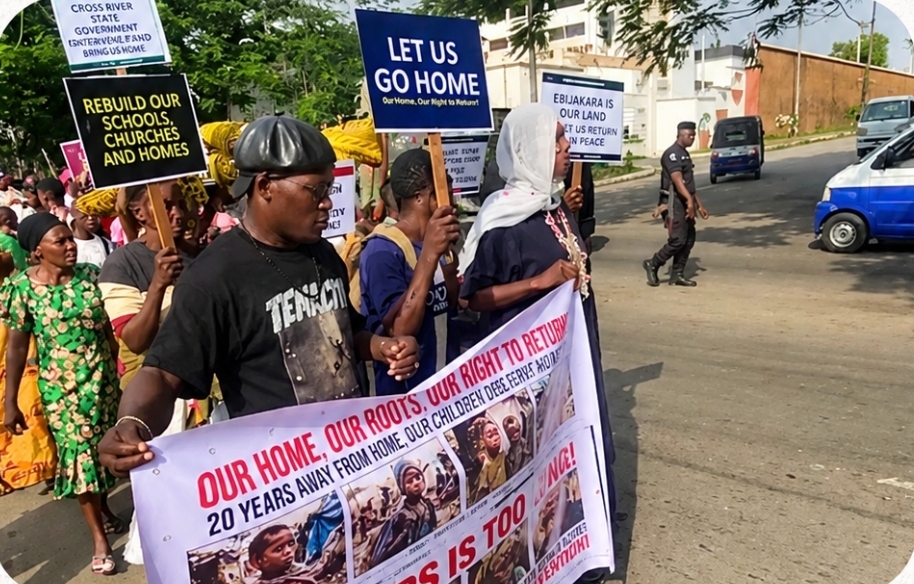
The protesters appealed to Cross River State Governor Bassey Otu to intervene in the dispute, citing years of separation from their homes, disrupted education and families scattered across different locations.
CALABAR, CROSS RIVER STATE — Residents of Ebijakara community in Abi Local Government Area of Cross River State have staged a peaceful protest in Calabar, demanding government intervention to facilitate their safe return to their ancestral land after more than 20 years in displacement.
The protesters, comprising women, youths and children, took to the streets of the state capital on Monday, carrying placards calling on the Cross River State Government to resolve the dispute that forced them to leave their homes more than two decades ago.
The displaced residents attributed their prolonged absence from Ebijakara to a communal conflict involving a neighbouring community, which they alleged invaded their ancestral land.
They said the displacement had disrupted family life, education and access to basic infrastructure, leaving generations of community members without stable homes in their ancestral settlement.
The protesters appealed to Governor Bassey Otu to intervene in the dispute and establish conditions that would enable them to return safely and rebuild their lives.
Speaking in a video interview during the protest, the last son of the late King of Ebijakara described the community's prolonged displacement as a painful experience, disclosing that both his father, the king, and his mother, the queen, died and were buried outside their ancestral homeland.
He appealed to the state government to help resolve the crisis and ensure that the people could return to Ebijakara in peace.
The protesters maintained that their demand was driven by the desire to reclaim their homes and restore their community, rather than seek revenge against any party.
They said every son and daughter of Ebijakara deserved to live in peace and dignity, with the opportunity to reconnect with their ancestral roots.
The woman leader of the community expressed deep distress over the prolonged displacement, particularly its effects on women, children and families.
Speaking during the protest, she said the crisis had scattered Ebijakara's children across different parts of the country, making it increasingly difficult for families to reunite in their homeland.
“Our eyes, we cannot see fine because of tears. So those things, we are not happy,” she said.
She explained that some parents struggled to persuade their children to return because homes and basic facilities were no longer available to accommodate them.
“Sometimes, they will call us. You ask your child that, try come home. I say, ah, me, why no bedroom? What thing I will come to? If I come there, one room, how are we going to manage?” she said.
The woman leader also raised concerns about the impact of the displacement on education, saying some children who should be attending school had been unable to continue their education.
“So even the ones that are supposed to go to school, they are not in school,” she said.
She further disclosed that some women in the community had been widowed as a result of the conflict.
“And some of us, we are widows. Our husband has died in the war, because of war,” she added.
Photographs published online by Cross River Watch showed protesters carrying placards with messages demanding resettlement, justice, security and government action.
Some of the inscriptions read: “Resettle Ebijakara Now,” “Ebijakara Will Not Be Silent About Its Future! We Demand Peace, Justice, And Action,” and “Our Land Is Not For Sale.”
Other placards highlighted the effects of the prolonged displacement on younger generations, with messages including “20 Years Away From Home, Our Children Deserve A Home, Security And A Future” and “20 Years Is Too Long.”
The protesters also called for the reconstruction of essential community infrastructure, including schools, churches and homes.
Messages such as “Rebuild Our Schools, Churches And Homes,” “Our River, Our Farms, Our Future,” and “Our Home, Our Roots, Our Right To Return Home!” underscored their concerns about restoring their livelihoods and rebuilding the community.
The displaced residents said they wanted a lasting resolution that would guarantee their safety and allow them to return to their ancestral land without fear.
They urged the state government to address the dispute and provide the necessary support for resettlement and the restoration of essential infrastructure.
The protest highlights the continuing human cost of communal conflicts, particularly for families who spend years away from their homes and struggle to rebuild their lives.
For the people of Ebijakara, the demand is not only about returning to their ancestral land but also about restoring family ties, securing their children's future and rebuilding a community they say they have been separated from for more than two decades.
The protesters called on the government to ensure that their prolonged displacement does not continue into another generation.
Discover Ugep News Blog will continue to follow developments concerning the Ebijakara community and any official response to the protesters' demands.